Ranking, being cited, and being usable are different
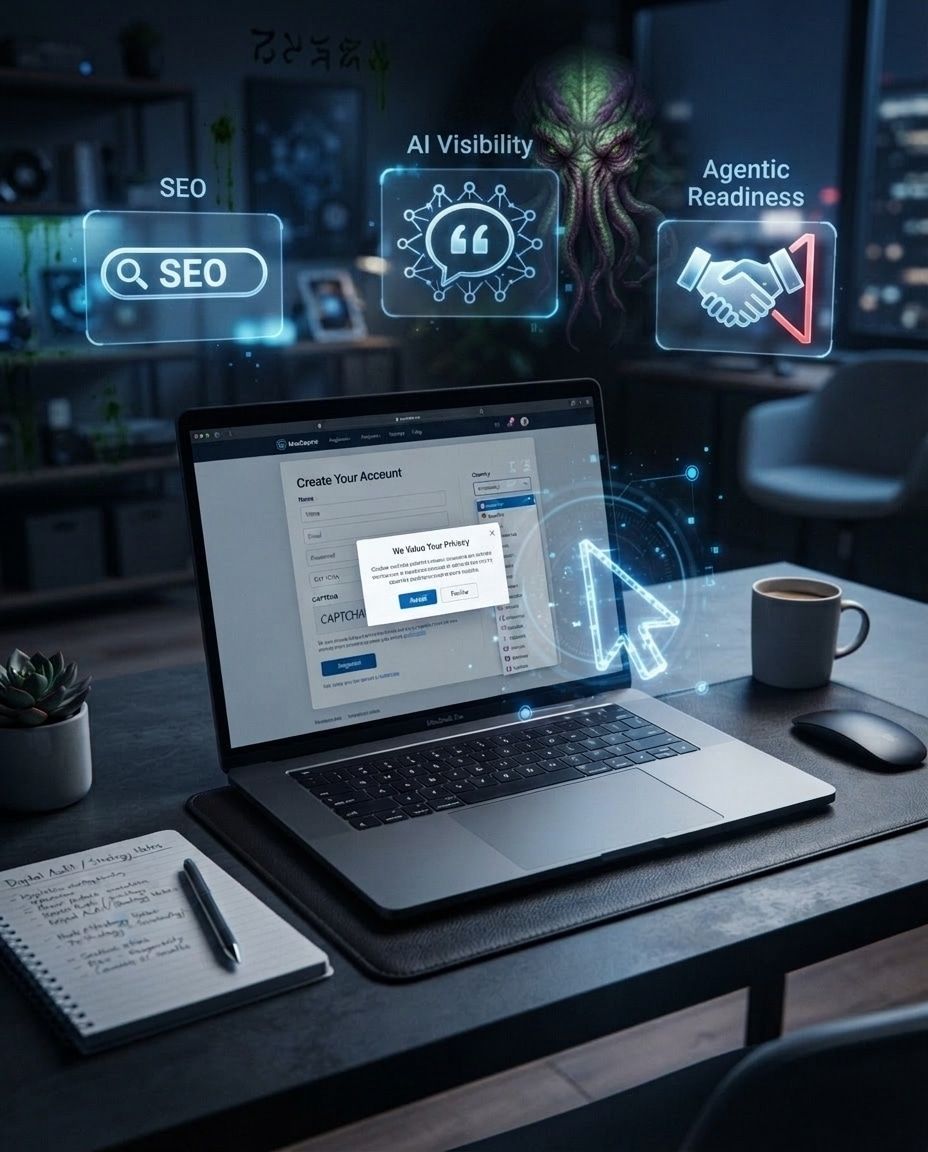
A page can rank #1 on Google, get cited by ChatGPT, and still fail once an AI agent tries to use it.
Three definitions. Three different things a website can pass or fail.
SEO means a search engine can crawl the site, understand it, and rank it. It’s been the job for 20-plus years, and most marketing teams have some facility here.
AI visibility means an AI system can understand the organization and cite it as a source. Newer, but teams are starting to pay attention: getting mentioned in a ChatGPT answer or an AI Overview instead of just a search result.
Agentic readiness means an AI agent can use the site to complete a task. And it’s the one almost nobody is testing for yet.
A site can nail the first two and still fail the third.
Picture a YMCA’s swim lesson page. It ranks on page one for “swim lessons near me.” An AI Overview cites it directly, correctly summarizing the age groups and price. By most metrics, that’s a success.
Wix’s AI Search Lab reported a real case just like this: a cookie pop-up sitting on top of the checkout button, and the agent couldn’t work out how to close it.
Now imagine that same failure on the page we just pictured.
It hits a dropdown menu for selecting the child’s age group, one that only populates its options after a specific click. The agent doesn’t click that way. It stalls.
Or the form field itself. A label that says “Participant” with no indication of what that means (the child? the parent? both?). A human infers this from context and photos of families on the page. An agent has none of that context to lean on.
These are small, ordinary pieces of interface friction, built by people, for people, who fill things out on autopilot every day. A person barely notices; they click around, guess, try again. An agent doesn’t have that instinct: it either has a clear path through, or it doesn’t.
SEO and AI visibility are both about being found and understood. Agentic readiness is about being usable, start to finish, by something that can’t ask a human nearby for help.
Most audits check individual pages: does this page load fast, is this page accessible, does this page rank. Fewer walk an entire journey end to end: search, click through, open the form, fill it out, submit, get a confirmation.
Open a browser-based agent such as the Claude Chrome extension, the ChatGPT agent, or Comet (Perplexity). Start clean: no autofill, no saved logins. Give it a plain-language goal, the way a real parent would type it. Don’t help. If it’s going to fail, let it fail, that’s the finding. Note exactly where it hesitates, misclicks, or gives up.
That’s a different kind of audit than most marketing teams have run before. I think it’s the one that’s going to matter more over the next few years.
Post 2 in a series on what AI agents mean for websites. Post 1 covered the shift from AI search to AI agents. Next: which fundamentals matter most for both humans and agents.